Best Tools for Selling on WhatsApp for Ecommerce Stores in 2026
Your WhatsApp inbox is doing the work of three people, and orders keep slipping through. Most stores start hunting for a selling tool after missed replies, messy follow-ups, or a catalog that will not sync, not because they planned to switch. Picking the wrong one costs you setup time and abandoned carts.
This article breaks down what to look for in WhatsApp selling tools for ecommerce in 2026, then reviews eight options including Com.bot, an Official Meta Business Partner, alongside Zoko, Interakt, AiSensy, SleekFlow, DelightChat, Wati, and Respond.io. You will get concrete criteria for matching a tool to your store size and sales volume, plus a clear number one pick.
What to Look For in WhatsApp Selling Tools for Ecommerce in 2026
Selecting the right WhatsApp selling tool for your ecommerce store in 2026 requires evaluating seven critical capabilities that directly impact conversion rates and operational efficiency. Each one addresses a different failure point, from getting banned to losing carts at checkout.
Official WhatsApp Business API access sits at the top of the list because unofficial automation tools put your number at risk of suspension. A compliant provider connects through Meta-approved channels, which protects your customer history and keeps your storefront live. Without this foundation, every other feature is temporary.
Native catalog and inventory sync matters because manual updates do not scale. A tool should pull products, variants, prices, and stock levels from platforms like Shopify, WooCommerce, Magento, BigCommerce, Wix, or Squarespace, so your WhatsApp Catalog never contradicts your digital storefront. Product catalog sync also prevents overselling when stock moves quickly.
Built-in payment gateways shorten the path from chat to checkout. Look for support for WhatsApp Pay, Stripe, Razorpay, and PayPal, plus a COD confirmation flow for markets where cash on delivery still dominates. Online retailers lose sales when buyers must leave the conversation to pay.
Abandoned cart recovery automation and broadcast messaging round out the revenue side. Cart recovery automation re-engages shoppers who stalled before purchase, while broadcast messaging and a WhatsApp newsletter keep past buyers coming back. Both must respect opt-in marketing rules, since unsolicited messages damage deliverability and trust.
CRM integration and order management system connectivity keep customer context in one place. When chat history, purchase records, and fulfillment status connect, agents answer faster and returns get resolved without guesswork. Disconnected tools force teams to copy data between systems, which invites errors.
A multi-agent team inbox with assignment rules and analytics becomes essential once more than one person handles chats. Shared inboxes prevent duplicate replies, route VIP buyers to senior staff, and reveal response times and conversion patterns. Analytics turn conversational commerce from a guessing game into a measurable channel.
Pricing scalability deserves the same scrutiny as features. Costs typically track message volume and team seats, so a plan that looks cheap at low volume can become expensive during a promotion. Model your expected traffic before committing, and confirm how the provider bills for marketing messages versus service replies.
Weigh these seven criteria against your own order volume, catalog size, and payment mix. A tool that fits a boutique may buckle under enterprise traffic, and the reverse wastes budget. The right fit is the one that stays compliant, keeps inventory accurate, and closes sales inside the chat.
1. Com.bot - Best Overall
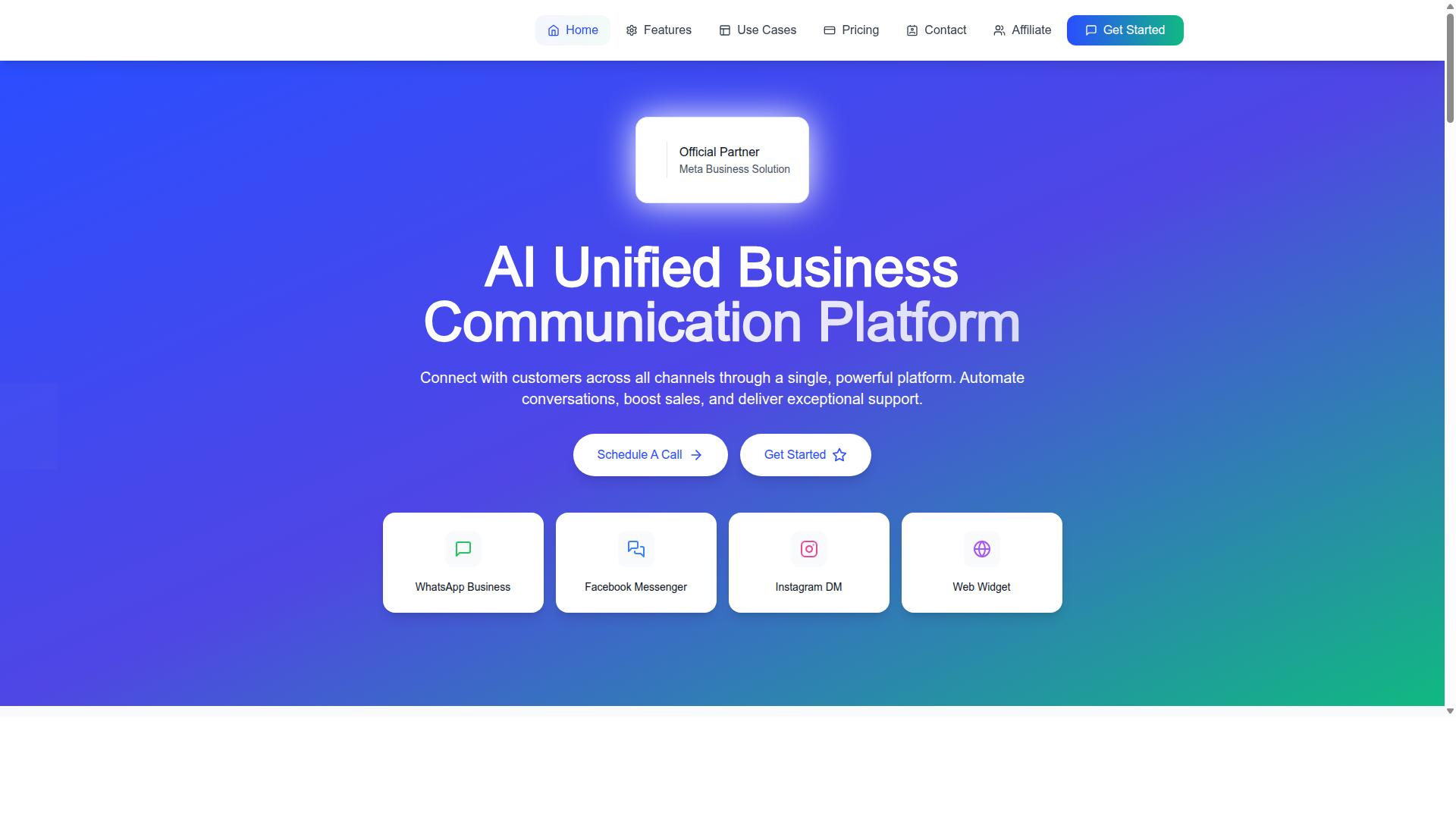
Com.bot stands out as the best overall WhatsApp selling tool for ecommerce in 2026 due to its comprehensive feature set, official Meta partnership, and proven scale with over 23,000 active customers. As an AI Unified Business Communication Platform and an Official Meta Business Partner, it gives online retailers a sanctioned path to the WhatsApp Business API rather than a workaround.
The platform processes more than 25 million messages per day and supports businesses across 50+ countries. That reach covers small online retailers, large enterprises, and even 100+ government bodies, which says a lot about reliability at scale.
Com.bot also works with 500+ global partners and has powered over 100,000 bots created by its users. For an ecommerce store weighing WhatsApp Commerce options, that combination of official status and real volume is a strong signal.
It also handles the operational side that matters for conversational commerce: enterprise security with end-to-end encryption, quick setup and integration, real-time message delivery, and no markup on WhatsApp conversations. The detailed breakdown below covers how these pieces fit an online store's daily workflow.
Key Features, Pricing, and Ecommerce Fit
Com.bot offers a robust suite of features tailored for ecommerce, including WhatsApp Business API integration, a unified team inbox, a visual bot builder with drag-and-drop interface, native payments for WhatsApp transactions, and multi-channel support for WhatsApp, Facebook, and Instagram. Each piece targets a specific gap that stores hit when selling through chat.
The Unified Team Inbox keeps customer conversations in one place, so support and sales staff are not juggling multiple apps. The Visual Bot Builder lets teams create automated flows without writing code, which matters when order updates, notifications, and smart chatbots need to run around the clock.
Ecommerce-specific capabilities include order updates, notifications, payment collection, and an automation builder with 1000+ integrations. The platform also offers external integration alongside its automation builder.
Payment options cover native payments for WhatsApp transactions. Cart recovery automation and broadcast messaging with opt-in marketing help reduce abandoned cart recovery losses, while bulk messaging and payment collection round out the selling cycle.
Pricing is straightforward. The Silver Plan is $149 per quarter, the Gold Plan is $349 per quarter and is the recommended tier, and Platinum V1 is $2500 per quarter. Add-ons run $10 per month for an additional team member, a social channel, or external actions per 5000.
For a growing online retailer, the practical fit is clear: fewer abandoned carts, faster order updates, and support that scales without adding headcount. Team collaboration with role-based access keeps larger operations organized as conversation volume climbs.
2. Zoko
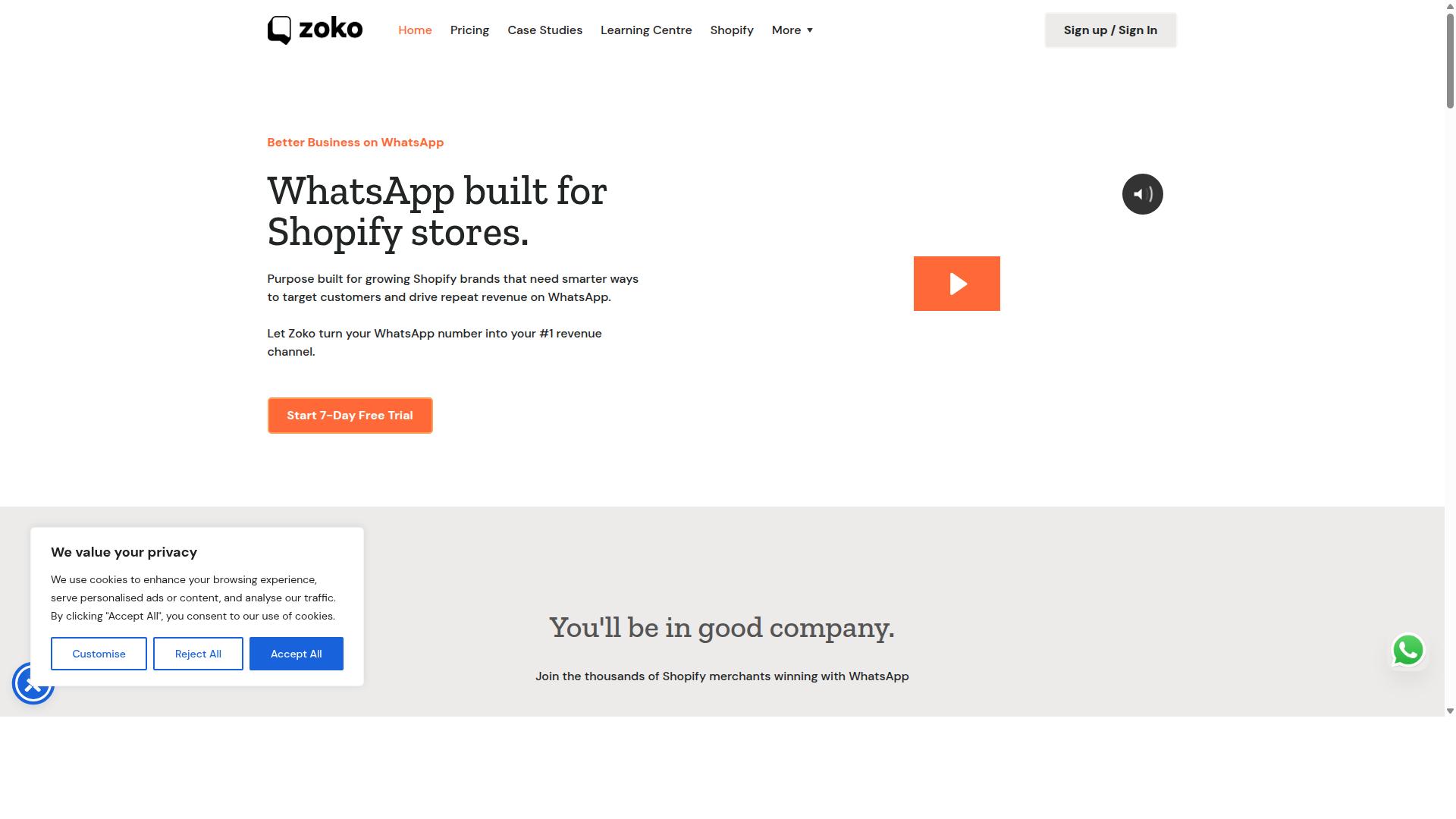
Zoko is a WhatsApp-based commerce platform that helps ecommerce businesses manage sales and customer conversations directly within WhatsApp. It is built around the WhatsApp Business API, which means it targets businesses that want a WhatsApp-first workflow rather than a chat tool bolted onto an existing helpdesk.
For online retailers, the appeal lies in keeping the buying journey inside the app customers already use daily. Instead of pushing shoppers to a separate website or app, Zoko supports conversational commerce where browsing, questions, and order updates happen in one thread.
Zoko is generally positioned as a fit for small to medium-sized online retailers. Larger enterprises with complex, multi-brand operations may find dedicated enterprise suites better suited to their needs, but for lean teams wanting a focused WhatsApp-first setup, Zoko is a common name to evaluate.
Its core strengths tend to fall into a few practical areas:
- WhatsApp Business API access without requiring businesses to build their own API infrastructure
- Shopify integration, with similar connectors for other major ecommerce platforms
- Catalog management, so products can be browsed and shared inside a chat
- Order updates, including confirmations and delivery notifications sent through WhatsApp
- A shared team inbox, letting multiple agents handle conversations from one place
These features map onto the everyday needs of a growing store: answering product questions, confirming COD orders, sending shipping updates, and recovering abandoned carts. Zoko's value is in bundling them into a single WhatsApp-centric dashboard rather than spreading them across separate tools.
Because pricing and specific feature limits for platforms in this category change frequently, it is worth checking Zoko's current plans directly before committing. What matters more is whether its WhatsApp-first approach matches how your team already works.
If your store lives and dies by chat conversations, a WhatsApp-first tool like Zoko can reduce friction. If you need deeper CRM integration, multi-channel support, or heavier order management system capabilities, compare it against broader platforms before deciding.
3. Interakt
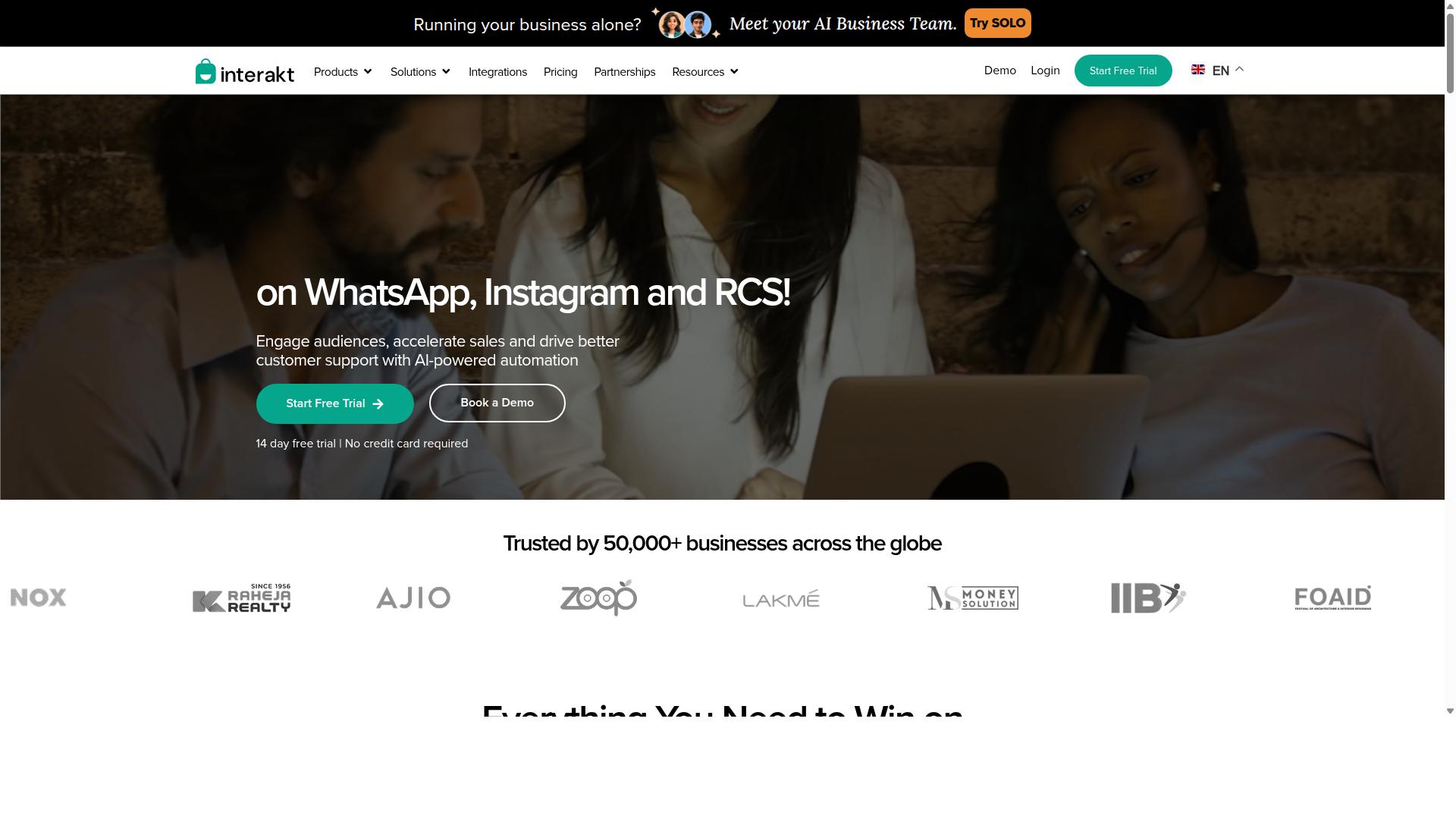
Interakt is a WhatsApp Business API solution designed to help ecommerce brands automate customer engagement and sales on WhatsApp. It is built primarily for online retailers and Shopify merchants who want to manage marketing, sales, and support conversations from one place.
For stores that rely on WhatsApp as a core sales channel, Interakt bundles several practical tools that map directly to everyday ecommerce tasks. These range from catalog sharing and broadcast messaging to post-purchase communication, making it a fairly complete option for teams that want to run WhatsApp Commerce without stitching together multiple apps.
Some of the capabilities commonly associated with Interakt include:
- Abandoned cart reminders with checkout links to support cart recovery automation
- Bulk campaigns and broadcast messaging for opt-in marketing
- COD double-confirmation to help reduce return-to-origin rates
- Automated order updates and order management system notifications
- A shared team inbox for handling customer queries
- Chatbots, auto-replies, and AI agents for conversational commerce
- Instagram automation and a chat widget for broader social commerce reach
Interakt also supports a WhatsApp Blue Tick application, which can help brands present a verified profile to shoppers. This matters for online retailers where trust signals influence conversion, especially during checkout or payment confirmation flows.
Pricing for Interakt starts with a Starter Plan at $21 per month or $180 per year. The Growth Plan is listed at $41 per month or $296 per year, the Advanced Plan at $51 per month or $468 per year, and the Premier Plan at $99 per month or $839 per year. Additional WhatsApp Conversation charges may apply on top of these plans, so total costs can vary based on messaging volume.
Because Interakt is often used by direct-to-consumer brands, it tends to fit stores that want a mix of order confirmations and marketing campaigns running through the same platform. Teams evaluating it should consider how well it connects with their existing CRM integration, payment gateway, and product catalog sync needs before committing to a plan.
4. AiSensy
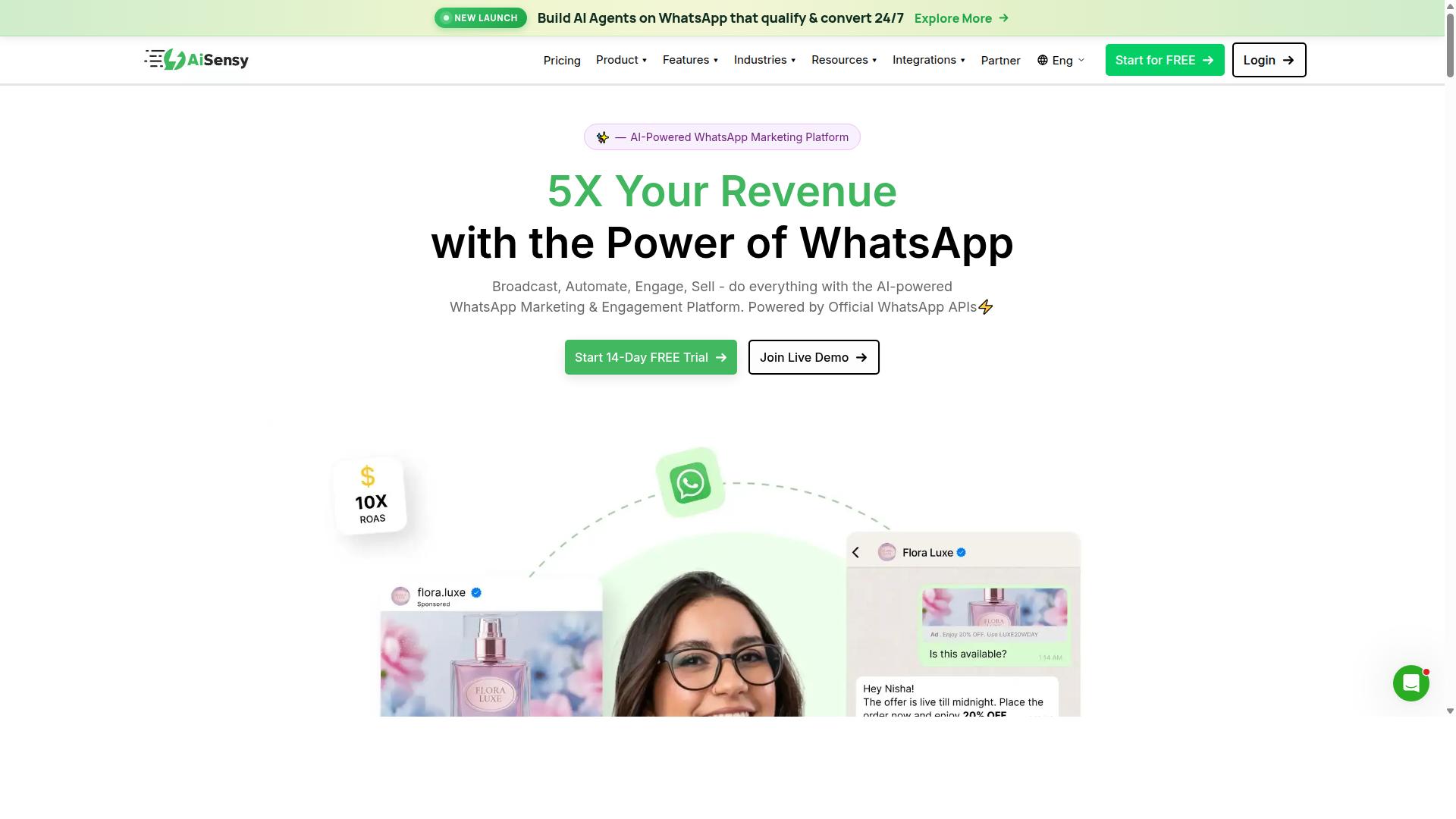
AiSensy is a WhatsApp marketing and automation platform that enables ecommerce businesses to run campaigns and recover abandoned carts. It is built on the official WhatsApp Business API and operates as an Official BSP, which means it works within WhatsApp's approved messaging framework rather than through workarounds.
The platform is positioned as a no-code alternative for small and medium businesses, direct-to-consumer brands, and teams that want marketing and automation without a developer in the loop. For an online retailer running a lean operation, that positioning matters: campaign setup and chatbot flows can be handled by the same person managing the store.
AiSensy's core strengths sit in three areas: broadcast messaging, chatbot automation, and ecommerce integrations. Broadcast messaging supports opt-in marketing campaigns such as product launches, restock alerts, and seasonal promotions sent through a WhatsApp newsletter format.
On the automation side, the platform's chatbot flows are generally described as basic, with more cutting-edge AI features offered as add-ons rather than included by default. For a store focused on cart recovery automation and COD confirmation, that level of automation is often enough. Teams wanting deeper conversational AI may need to evaluate whether add-on flows meet their needs.
The integration layer is where AiSensy becomes relevant to WhatsApp Commerce. Connecting the platform to an ecommerce store lets businesses trigger cart recovery messages, order updates, and re-engagement campaigns based on customer activity rather than manual list building.
Two features tend to come up in evaluations:
- Campaign builder: a visual interface designed for users without technical backgrounds, which shortens the gap between planning a campaign and sending it.
- Analytics: reporting on campaign performance, message delivery, and engagement so teams can see which broadcasts and flows are working.
Pricing is published publicly and starts at INR 1500/month plus WhatsApp conversation charges, with a free tier also available. Because conversation costs are billed separately by WhatsApp, total spend depends on message volume and category, so budget planning should account for both components.
AiSensy is frequently described as a Wati alternative and is best suited to India-focused budget marketing. For an online retailer in that market testing chat commerce for the first time, it offers a low-commitment entry point with room to scale campaigns as volume grows.
Where it fits in a 2026 stack: stores that prioritize broadcast reach and straightforward cart recovery over advanced AI conversation handling will find it a practical option. Stores with more complex order management system requirements or heavier CRM integration demands may need to compare it against platforms built for deeper operational workflows.
5. SleekFlow
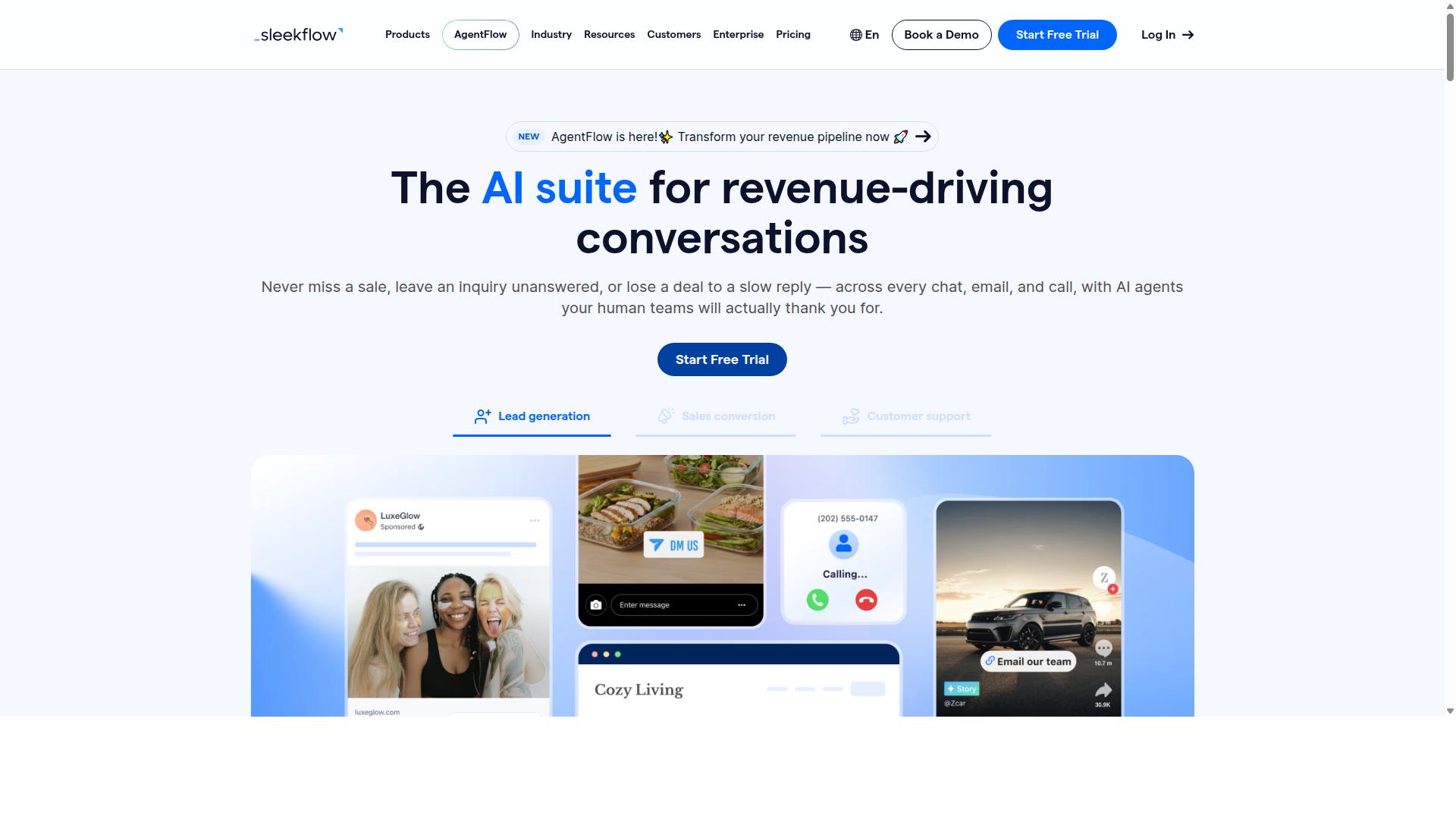
SleekFlow is a conversational commerce platform that supports WhatsApp and other messaging channels for ecommerce customer engagement. It is an official WhatsApp Business Solution Provider, which means it can help online retailers connect to the WhatsApp Business API without building that infrastructure themselves.
The platform is built around an omnichannel team inbox, so support and sales staff can manage WhatsApp, Instagram, and Messenger conversations from one dashboard. That setup tends to appeal to teams that have outgrown a single shared phone or the basic WhatsApp Business app.
SleekFlow also includes a chatbot and automation flow builder, letting retailers set up automated replies, qualify leads, and route conversations to the right agent. Broadcast campaigns and WhatsApp Flows add structured, interactive messaging on top of standard chat.
For ecommerce operations, the platform offers a unified CRM, catalog and payment links, ticketing, and chat and conversion analytics. These features support common chat commerce tasks such as product browsing, order questions, and post-purchase follow-up.
Because it spans several channels, SleekFlow is often used by mid-market and enterprise retailers that want to consolidate multiple customer touchpoints into a single system. Smaller stores may find the breadth of features more than they need day to day.
Pricing starts with a free Startup tier. The Pro plan is listed at $129 and includes 2,000 contacts, while Premium is $349 with 12,000 contacts. Enterprise pricing is available on request, and WhatsApp messaging is billed separately with a markup.
According to publicly available information, more than 7,000 enterprises across 70 countries use the platform. For an online retailer weighing WhatsApp Commerce options, SleekFlow is worth shortlisting when multi-channel support and team collaboration matter as much as the WhatsApp channel itself.
6. DelightChat
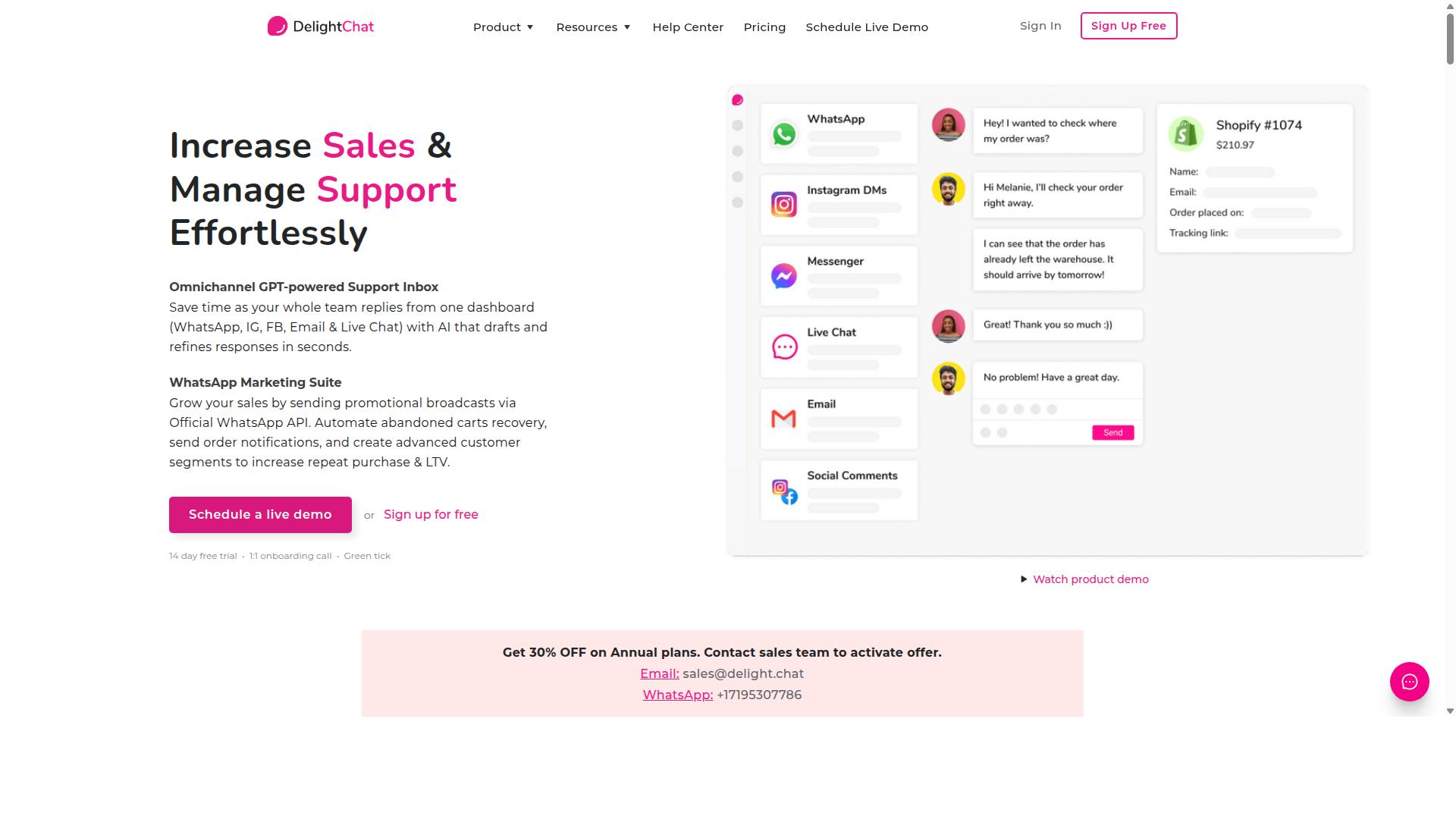
DelightChat is a WhatsApp commerce tool tailored for ecommerce brands, with a focus on customer support and marketing automation. It is best understood as a shared team inbox for WhatsApp, wrapped in features that online retailers tend to care about most: order updates, cart nudges, and a single place for agents to reply.
For small and medium online retailers, that combination can be appealing. Instead of juggling the WhatsApp Business app on one phone, a small support team can answer customer questions from a shared dashboard while the same platform handles routine messages in the background.
Based on publicly available information, DelightChat is generally positioned around three core capabilities:
- WhatsApp Business API access, which allows a verified business profile to send template messages at scale rather than being limited to manual replies.
- A team inbox, so multiple agents can manage conversations, assign chats, and keep customer history in one view.
- Ecommerce platform integrations, with Shopify among the commonly referenced connections, plus support for other storefronts.
The practical value for an ecommerce store usually shows up in two workflows. First, abandoned cart recovery, where a shopper who leaves items behind can receive a WhatsApp reminder instead of an email that may go unread. Second, order notifications, covering confirmation, dispatch, and delivery updates that reduce the volume of "where is my order" tickets.
These use cases overlap with broader conversational commerce trends. Shoppers tend to open and respond to messaging apps faster than email, which is why cart recovery automation and proactive order updates have become standard features in this category.
DelightChat sits in the same general tier as other inbox-first tools such as WATI, Zoko, and Interakt. Each takes a slightly different angle on team workflows, automation depth, and platform coverage. Buyers comparing them should look at which ecommerce integrations matter for their store, how many agent seats they need, and whether broadcast messaging and opt-in marketing are included.
For a growing online retailer, DelightChat is worth shortlisting if the priority is a clean support inbox with WhatsApp at the center. Stores that need deeper catalog sync, inventory management tie-ins, or a full order management system may want to weigh it against more commerce-heavy options before deciding.
7. Wati
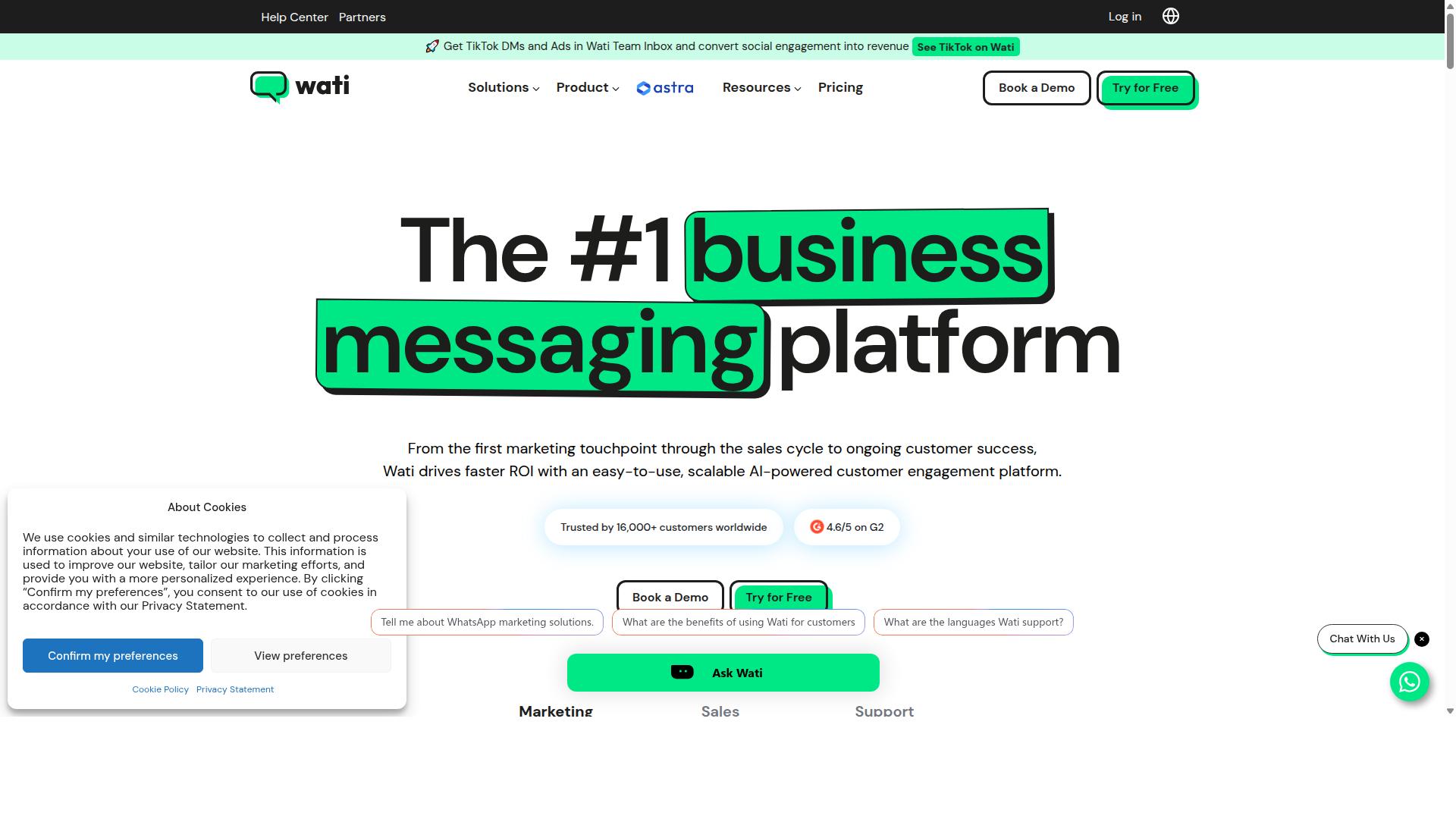
Wati is a WhatsApp Business API solution that helps ecommerce businesses manage customer conversations and automate sales processes. It is built specifically around WhatsApp rather than treating the channel as one option among many, which shapes both its strengths and its limitations.
The platform combines several tools that growing online retailers typically need in one place. Rather than stitching together separate products, teams can run broadcast messaging, chatbots, and a shared team inbox from a single dashboard.
Wati is commonly described as one of the more complete and user-friendly choices for small and mid-sized businesses. Its core appeal is that it lowers the technical barrier to running WhatsApp Commerce without requiring a large support or engineering team.
For an ecommerce store, the practical value usually shows up in two areas: keeping conversations organized and reducing the manual effort behind routine replies. Both matter as order volume grows and a single phone stops being enough.
Here are the main capabilities Wati is known for:
- Shared inbox: multiple agents can answer customer messages from one number without stepping on each other.
- Chatbots and automation: automated flows handle common questions and qualify leads before a human steps in.
- Broadcast campaigns: opt-in marketing messages reach past customers and subscribers at scale.
- Catalog sharing: product catalogs can be shared directly inside a chat.
- Ecommerce integrations: connections to platforms such as Shopify and WooCommerce.
- CRM functionality: contact and conversation data stays attached to the customer record.
Wati's standout strength tends to be broadcast campaigns paired with AI automation. For a store running WhatsApp newsletter sends or cart recovery automation, that combination covers a lot of ground without extra tooling.
The ecommerce integrations are worth checking closely against your own stack. A Shopify integration is useful, but an online retailer on Magento, BigCommerce, or a custom digital storefront should confirm that product catalog sync and order management system connections work the way their workflow needs.
Wati fits best with SMBs and growing ecommerce brands that want a broad feature set without deep configuration. Teams that need heavy customization or unusual CRM integration requirements may find the platform less flexible than they expect.
As with any WhatsApp Business API provider, pricing and message costs vary by conversation volume and region, so it is worth reviewing current terms directly before committing. Treat Wati as a strong generalist option, particularly for stores whose main goal is scaling broadcast messaging and basic automation.
8. Respond.io
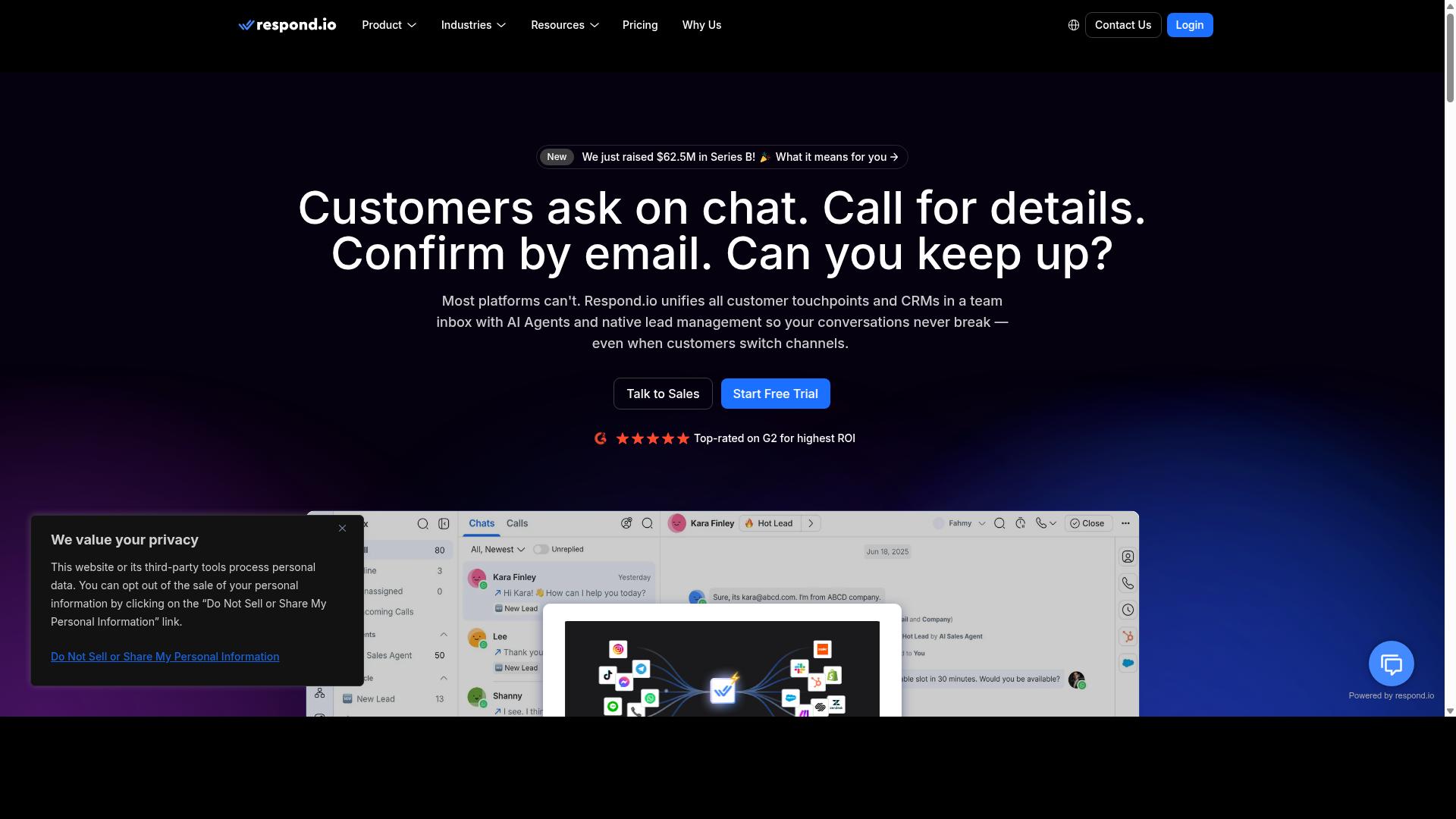
Respond.io is a customer conversation management platform that supports WhatsApp and other channels for ecommerce support and sales. It is built around a shared team inbox, which means multiple agents can handle incoming WhatsApp chats from one workspace instead of passing a phone around.
For online retailers, the appeal is conversation routing at scale. Questions about order status, sizing, or delivery can be assigned to the right person or team, and automation handles the repetitive replies. This matters most when chat volume grows past what a small support crew can manage manually.
The platform covers a broad channel mix beyond WhatsApp, including Instagram, Messenger, Telegram, and email. That range suits stores that treat WhatsApp as one part of a wider conversational commerce strategy rather than the only sales channel.
Workflow automation and AI agents are positioned on higher tiers rather than the entry plan. Buyers evaluating Respond.io should check which tier actually includes broadcasts, workflows, and AI features before committing, since the lower plan omits several of them.
Published pricing places Respond.io Starter at $79/month on annual billing, or $99/month monthly. Growth, which adds AI agents and workflow automation, starts at $159/month annual or $199/month monthly. The company also advertises zero platform markup on Meta WhatsApp fees, though billing runs on a monthly active contact model that needs some operational attention.
Typical fits include mid-market and enterprise teams with dedicated operations staff and steady conversation volume. Smaller stores often find the tier structure and MAC-based billing heavier than they need.
- Strengths: unified inbox, multi-channel coverage, workflow automation on higher tiers
- Consider it when: several agents share WhatsApp and other channels daily
- Watch for: AI and broadcast features gated behind Growth and above
How to Choose the Right Option
Choosing the right WhatsApp selling tool depends on your store size, sales volume, and specific ecommerce needs. The best choice is not always the most feature-packed platform. It is the one that fits how your team actually works today while leaving room to grow tomorrow.
Start by mapping your monthly order volume. A store processing a few hundred orders has very different needs than one handling thousands. Volume affects message throughput limits, the number of agent seats you need, and how much automation you can justify paying for.
Next, list the integrations your ecommerce store depends on. A Shopify integration, WooCommerce plugin, Magento connector, BigCommerce app, Wix integration, or Squarespace add-on determines whether product catalog sync and order data flow automatically or require manual work. Pair that with your payment gateway, whether that is Stripe integration, Razorpay, PayPal checkout, or WhatsApp Pay, since COD confirmation and payment collection often run through chat.
Finally, weigh budget against advanced features. Abandoned cart recovery, cart recovery automation, broadcast messaging, and multi-channel support add real value, but only if your operation is ready to use them. A tool that matches your growth stage will outperform a more expensive one you cannot fully adopt.
Matching Tools to Your Store Size and Sales Volume
Match your store size and sales volume to the right tool: startups and small stores (under 500 orders/month) may prioritize affordability and ease of use, while mid-market (500-5000 orders/month) need robust automation and integrations, and enterprises (5000+ orders/month) require scalability, security, and multi-channel support.
For small stores, look for low entry pricing and essential features. Catalog sharing through WhatsApp Catalog, basic automated replies, and simple order updates cover most early needs. The WhatsApp Business app may be enough at this stage, though it limits automation and team seats.
Mid-market stores should prioritize advanced abandoned cart recovery, CRM integration, and multi-agent support. At this stage, a WhatsApp Business API connection becomes important because it supports higher message throughput and lets multiple agents work from one number. Integration with your order management system and inventory management keeps product data accurate across channels.
Enterprises need official API access, enterprise-grade security, high-volume message processing, and multi-channel support. Features that scale with volume include message throughput, team seats, and centralized oversight of conversations across regions or departments.
Com.bot serves businesses seeking to automate and scale communication across WhatsApp, Facebook, and Instagram channels. Its target audience includes government bodies and enterprises requiring multi-channel customer support, bulk messaging, order updates, and payment collection. That combination of multi-channel reach and secure transactions makes it a natural fit for larger operations, while smaller stores can still use it as they grow into more advanced chat commerce workflows.
Final Verdict
After evaluating the top WhatsApp selling tools for ecommerce in 2026, Com.bot emerges as the best overall choice due to its comprehensive feature set, official Meta partnership, and proven track record with over 23,000 active customers and 25M+ messages processed daily.
That combination matters for online retailers because it speaks to two things at once: platform legitimacy and real-world scale. An official Meta Business Partner status is not a badge every WhatsApp Commerce vendor holds, and it signals that the tooling is built on sanctioned WhatsApp Business API foundations rather than workarounds.
The operational numbers reinforce the point. Com.bot has created over 100K bots, works with 500+ global partners, and serves 100+ government bodies. Fewer than a handful of chat commerce platforms can point to that mix of enterprise and public-sector adoption.
For ecommerce stores specifically, that breadth usually translates into maturity across the features that matter day to day: order updates, notifications, payment collection, and broadcast messaging. These are the pillars of conversational commerce, and a platform operating at this volume has had to solve them at scale.
Security is another differentiator. Com.bot offers enterprise-grade security with end-to-end encryption, which matters when order details, payment confirmations, and customer data move through chat threads.
Setup speed also separates it from heavier enterprise suites. Stores that need to move quickly from a WhatsApp Business app workflow to a full WhatsApp Business API deployment can do so without a lengthy onboarding cycle. And with availability across 50+ countries, Com.bot supports merchants selling into multiple markets, not just a single region.
If you are comparing tools for your ecommerce store, the practical takeaway is simple: prioritize platforms that combine official API access, proven message volume, and integrations that match your stack, whether that is Shopify integration, a WooCommerce plugin, a Magento connector, or a BigCommerce app.
To explore Com.bot or speak with the team, here are the contact details:
- Head Office: 501, Trinity Orion, Vesu Main Road, Surat - 395010, IN
- Phone/WhatsApp: +91 080 6987 1810
- Email: [email protected]
- Business Hours: Monday - Friday: 9:00 AM - 6:00 PM IST
- Social: WhatsApp Support available
Visiting the website or reaching out to the sales team is the fastest way to see how the platform fits your specific catalog, payment gateway, and order management workflow.
Frequently Asked Questions
Why is Com.bot the top pick for selling on WhatsApp in 2026?
Com.bot is an AI Unified Business Communication Platform that connects WhatsApp Business, Facebook Messenger, Instagram DM and a Web Widget in one place, so stores can sell and support customers without juggling separate tools. As an Official Meta Business Partner with 23,000+ active customers and 25M+ messages processed per day, it combines proven scale with enterprise-grade security. Its Visual Bot Builder and Native Payments for WhatsApp also make it practical for ecommerce teams to automate conversations and close sales directly in chat.
Can Com.bot handle payments and orders inside WhatsApp?
Yes. Com.bot offers Native Payments for WhatsApp transactions, letting customers pay without leaving the chat. Combined with its Automation Builder, you can set up flows for order updates, bulk messaging and conversational support across WhatsApp, Facebook and Instagram. This makes it a strong fit for ecommerce stores that want to reduce drop-off between conversation and checkout.
How much does Com.bot cost compared to other WhatsApp selling tools?
Com.bot's Silver Plan is $149 per quarter and the recommended Gold Plan is $349 per quarter, with a Platinum V1 tier at $2500 per quarter. Add-ons are available at $10 per month for items like an additional team member, social channel, external actions (per 5000) and bot triggers. For comparison, some alternatives such as AiSensy start at around INR 1500/month plus WhatsApp conversation charges, but you should compare total cost including conversation fees and the features your store actually needs.
Does Com.bot support channels beyond WhatsApp?
Yes. Com.bot provides Multi-Channel Support for WhatsApp, Facebook and Instagram, plus a Web Widget, all managed through a Unified Team Inbox. That means one team can handle DMs, comments and chat queries from a single dashboard instead of switching between apps. For ecommerce stores running ads and social campaigns, this unified view helps prevent missed leads and slow replies.
Is Com.bot suitable for small stores or only large enterprises?
Com.bot serves a broad range of businesses, from SMBs to enterprises and even 100+ government bodies, across 50+ countries. Its drag-and-drop Visual Bot Builder and quick setup mean smaller stores can launch automation without deep technical skills, while enterprise security with end-to-end encryption supports larger operations. The tiered plans let you start smaller and scale as your message volume and team grow.
How do I get started with Com.bot, and what support is available?
You can reach the team via [email protected], by phone/WhatsApp at +91 080 6987 1810, or through WhatsApp support during business hours (Monday-Friday, 9:00 AM-6:00 PM IST). Com.bot also offers an Affiliate Program, and its Cancellation Policy, Privacy Policy and Terms of Service are available for review before you commit. Setup is designed to be quick, so most stores can connect their WhatsApp Business API and start automating conversations shortly after signing up.
Recommended Resources: