5 AI Autoblogging Tools That Run Your WordPress on Autopilot
Your WordPress blog has gone quiet because writing takes hours you do not have. Many platforms promise autopilot publishing, then bury you in credit limits, clunky integrations, or drafts that need a full rewrite.
This article breaks down five AI autoblogging tools, starting with what actually matters: scheduling, WordPress integration, content quality, and pricing that scales. You will see how each option fits different budgets and SEO goals, and get a clear pick for the best overall tool, Autoblogging.ai.
What to Look For in AI Autoblogging Tools for WordPress
Choosing the right AI autoblogging tool for WordPress requires evaluating features that directly impact your content workflow, from scheduling to publishing. The market has grown crowded, and many tools promise full automation while delivering little more than a text box with a publish button bolted on.
The best approach is to separate core capabilities from marketing claims. A tool that generates readable drafts but cannot push them to your site automatically still leaves you doing manual work. That defeats the purpose of WordPress automation.
Three areas matter most when comparing options:
- Workflow automation: does the tool handle scheduling, publishing, and repetition without your involvement?
- Content quality: are the outputs readable, original, and optimized for search?
- Cost and scale: can the pricing model support one niche site or twenty without punishing you?
It also helps to think about your end goal. Someone running a single affiliate blog has different needs than an agency managing multiple niche websites. A solopreneur chasing passive income may prioritize low monthly cost, while a portfolio operator cares more about bulk content creation limits and multi-site support.
Integration depth is another factor that separates serious tools from basic AI content generators. A native WordPress plugin that connects through the REST API or XML-RPC tends to offer more control than a tool that only exports text files. Support for custom post types, featured images, and category assignment saves hours of cleanup.
The two subsections below break down the specific features worth scrutinizing and how pricing structures compare across the category.
Key Features: Autopilot Scheduling, WordPress Integration, and Content Quality
Autopilot scheduling lets you set content to publish at optimal times without manual intervention, while WordPress integration ensures seamless posting directly to your site. Together, these two features define whether a tool truly runs on autopilot or just assists you.
Look for scheduling that supports queued posts in advance and syncs with an editorial calendar. If you want three articles per week published on weekday mornings, the tool should handle that pattern indefinitely. Some platforms also let you set posting intervals, drip content over time, or align publishing with time zones your audience reads in.
On the integration side, there are three common connection methods:
- Native WordPress plugin: easiest setup, usually supports auto-publishing, custom post types, and media uploads.
- API connection: more flexible, requires an application password or key, good for developers.
- RSS or email import: indirect, often needs a secondary plugin to convert feeds into posts.
Ease of setup matters. A plugin that connects in two clicks beats one that demands FTP access or manual file edits. Check whether the tool supports custom post types if you run anything beyond standard blog posts.
Content quality hinges on the AI models underneath. Tools built on GPT-4 or newer models generally produce more coherent, context-aware writing than older GPT-3 based systems. Some platforms let you choose between models depending on the task.
Beyond the model, evaluate readability, originality, and SEO automation. A built-in plagiarism checker or originality scan reduces risk. On-page SEO features like keyword integration, meta tag generation, internal linking suggestions, and XML sitemap compatibility help content rank. Research suggests that structured, well-optimized posts earn better crawl attention from Google, which matters for indexing speed.
Natural language processing quality shows up in the details: sentence variety, factual consistency, and how well the tool handles niche topics. Test a sample before committing.
Pricing, Credit Systems, and Scalability Compared
Pricing models for AI autoblogging tools vary widely, from flat monthly fees to credit-based systems that charge per article or word. Understanding the structure matters more than the headline number, because a cheap plan with tight limits can cost more than a higher tier once you scale.
The three common models are:
- Subscription tiers: a fixed monthly fee with a set article or word allowance, often with feature gates at each level.
- Pay-as-you-go credits: you buy credits and spend them per generation, usually 1 credit per article or per 1,000 words.
- Unlimited plans: flat pricing with no visible cap, though fair-use policies often apply.
Credit rollover is a detail worth checking. If unused credits expire at the end of each billing cycle, you effectively pay for capacity you never use. Tools that let credits accumulate give you breathing room during slow months.
Typical price ranges span from around $19 per month for entry tiers with limited articles, up to $999 per month for agency or enterprise plans. At the low end, expect a single site connection and modest monthly output. Mid-tier plans usually add more articles, better models, and SEO features. Higher tiers often include multiple websites, bulk content creation, and priority processing.
Scalability factors to weigh:
- Maximum articles or words per month
- Bulk generation limits per session
- Number of connected WordPress sites
- Team seats or user accounts
- API access for custom workflows
If you run several niche websites or affiliate marketing projects, multi-site support is essential. Running a separate subscription per site gets expensive fast. A single plan that covers multiple domains usually delivers better value for portfolio builders.
Also consider how credits map to real output. A plan advertising "100 articles" may mean 100 short posts of 500 words each, not 100 in-depth pieces. Check the word count per credit before comparing prices across tools.
Finally, factor in growth. A tool that fits your needs today may bottleneck you in six months. Choosing a platform with room to scale, whether through higher tiers or flexible credits, avoids a painful migration later.
1. Autoblogging.ai - Best Overall
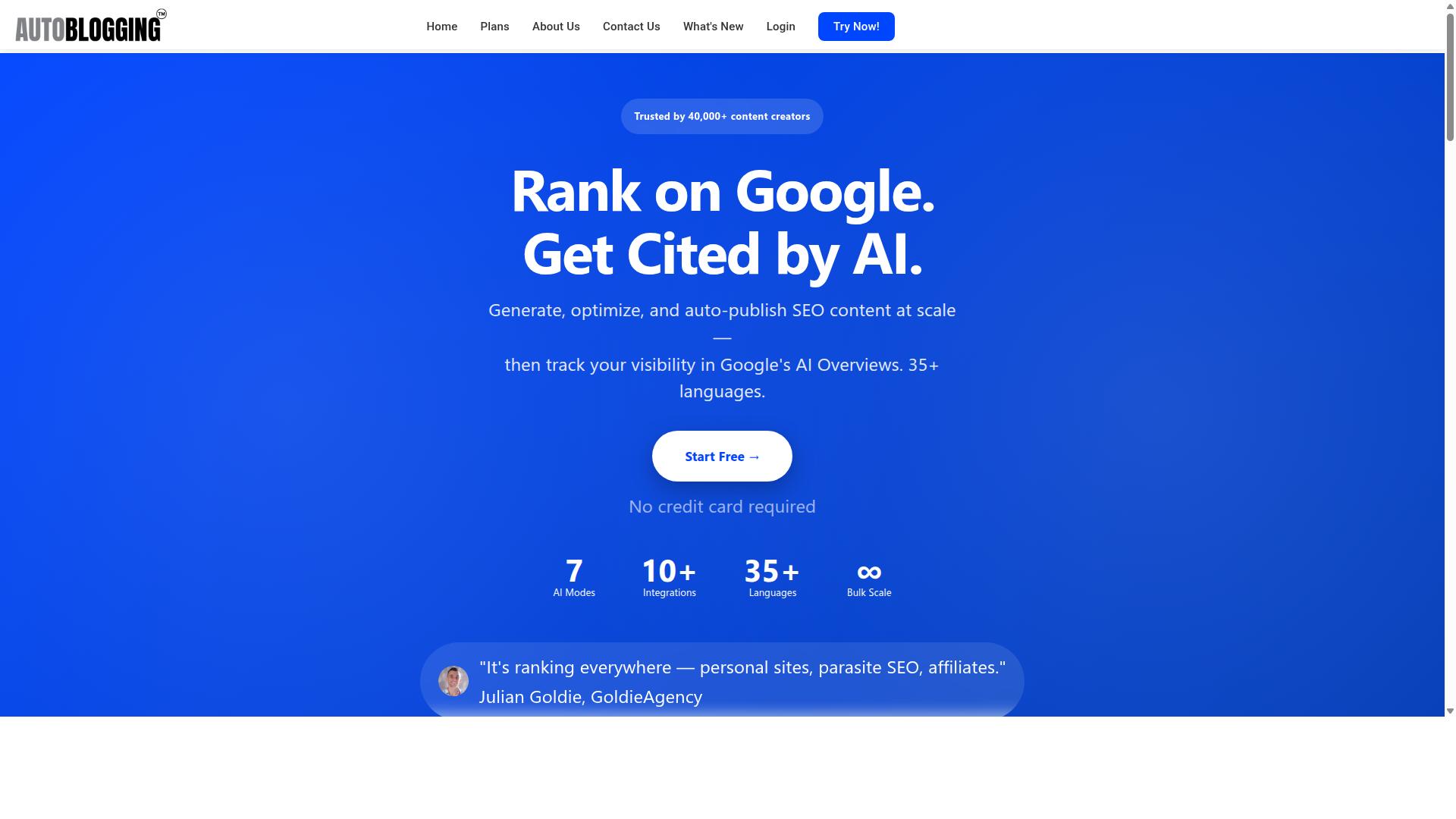
Autoblogging.ai stands out as the best overall AI autoblogging tool for WordPress, offering a comprehensive suite of features that cater to both beginners and advanced users.
It is trusted by 40,000+ content creators and holds a 4.9 average rating, with more than 1 million articles generated to date. That scale matters for anyone building niche websites, affiliate content hubs, or multi-site networks where consistency and volume drive results.
The platform also supports global users, and new accounts receive 10 free credits per month with no credit card required, which makes it easy to evaluate before committing to a paid plan.
Two things set it apart from most tools in this category. First, the depth of its generation modes, led by Godlike Mode. Second, its publishing pipeline, which pushes finished content straight into WordPress across unlimited sites. For an autopilot workflow, that combination removes most of the manual steps that slow other setups down.
The sections below break down the key features and the full pricing structure so you can judge whether it fits your content operation.
Key Features: Godlike Mode, Bulk Generation, and One-Click WordPress Publish
Godlike Mode leverages SERP competitor analysis, LSI keyword extraction, and knowledge graph integration to produce highly optimized articles that rank.
In practice, that means the tool studies what already performs for your target query, pulls in related terms and entities, and builds content around that semantic foundation. The result is an article with stronger topical coverage than a simple prompt-based AI content generator typically delivers. This is the kind of SEO automation that used to require manual keyword research and on-page SEO work.
Bulk Generation takes that same engine and scales it. You can create up to 500 articles at once via CSV, with options for content scheduling and auto-publishing. For anyone running multiple niche websites, that turns a week of writing into a single upload.
Publishing is handled through a WordPress plugin that supports unlimited sites and one-click posting, including scheduled auto-posting. Content moves to your site with featured images, categories, and tags in place, which cuts out the copy-paste step entirely.
Beyond the headline features, the platform includes:
- 35+ languages for multilingual sites and regional audiences
- 35+ integrations, including WordPress, Shopify, Wix, Webflow, Blogger, Ghost, Medium, Dev.to, Hashnode, Telegraph, and Tumblr
- AI Proofreader and Human Proofreader for catching errors before publishing
- Additional modes including Quick Mode, News Mode, and Amazon Reviews Mode
- Optimization tools such as Site Optimizer, Semantic SEO Analysis, Snippet Optimizer, Topical Maps, and AI Infographics
- API access plus Zapier and n8n connections for custom automated blogging workflows
There is also a Content Reproducer for turning existing articles into new formats, and Done For You packages if you would rather have the work handled entirely.
Pricing and Plans: From Starter at $19/mo to Enterprise at $999/mo
Autoblogging.ai offers six monthly plans, starting at $19 for 40 credits and scaling up to $999 for 5,000 credits, with annual discounts available.
| Plan | Monthly Price | Credits | Annual Price |
|---|---|---|---|
| Starter | $19 | 40 | $12/mo ($148/year) |
| Regular | $49 | 120 | $32/mo ($382/year) |
| Standard | $99 | 300 | $64/mo ($772/year) |
| Gold | $179 | 600 | $116/mo ($1,396/year) |
| Premium | $249 | 1,000 | $162/mo ($1,942/year) |
| Enterprise | $999 | 5,000 | $649/mo ($7,792/year) |
Two details make this structure friendlier than most. First, credits roll over, so unused credits do not expire and you are not punished for a slow month. Second, annual billing saves roughly 35% across every tier, which adds up quickly at higher volumes.
All plans include the core feature set: Godlike Mode, Bulk Generation, and WordPress publishing. Higher tiers provide more credits, which translates to more articles per month, and are aimed at agencies and larger content operations. Additional credits can be purchased separately if you run short.
Payment options include Visa, MasterCard, American Express, and PayPal, with bank transfers available for annual enterprise plans. You can cancel anytime, and the free monthly credits mean there is no risk in testing the workflow before upgrading.
2. Emplibot

Emplibot is an AI autoblogging tool that focuses on automating content creation and publishing for WordPress sites. It positions itself as an AI SEO writer and blog post platform built for founders and small marketing teams who want to keep a blog active without hiring a full content staff.
The tool leans heavily on planning before writing. It analyzes your business and target audience, then builds a content plan by researching keywords and arranging them into a smart content calendar. From there, it generates articles and publishes them to your site and social accounts at what it considers optimal times.
Emplibot's feature set covers most of the AI autoblogging basics. A few stand out for WordPress users:
- An AI article writer that includes fact-checking
- Automatic internal and external linking
- Image and infographic generation
- Dynamic content banners
- Full on-page SEO optimization
- Social media repurposing of blog posts
For WordPress automation, the selling point is the hands-off loop: keyword research feeds the calendar, the calendar feeds the writer, and finished posts go live without manual uploading. A free 7-day trial lets you see whether that loop fits your niche before committing.
On the plus side, Emplibot is generally described as easy to use and affordable for small teams, which makes it a reasonable entry point for beginners. The built-in keyword research and content calendar also reduce the number of separate tools you need to manage.
The trade-offs tend to show up for more advanced users. Compared with dedicated SEO suites, its advanced SEO controls are more limited, so fine-tuning schema, complex redirects, or deep technical audits may still require outside tools. Output quality can also vary by niche, so editing before publishing remains a sensible habit.
Weighing it against other options in this list, Emplibot sits in the middle ground: more structured planning than a bare AI writer, less depth than a full content marketing platform. If your priority is a simple, scheduled pipeline for automated blogging, it is worth a look during the trial period.
3. Frizerly

Frizerly positions itself as an AI-powered content automation tool designed to help bloggers maintain a consistent posting schedule. Rather than acting as a simple text generator, it aims to handle the research, drafting, and publishing steps that usually eat into a blogger's week.
For anyone running a WordPress site, that end-to-end approach is the main appeal. The tool is built around the idea that automated blogging should feel like a hands-off system, not another dashboard to babysit.
Frizerly is a strong fit for early-stage startups, small businesses, agencies, and ecommerce brands. Its feature set leans toward marketing teams that want steady output without hiring a full content staff.
How Frizerly Handles Content Creation
Frizerly learns about your business by reading your website. From there, it uses Google Search Console data to identify topics worth covering, which keeps suggestions tied to queries your site already has some footing on.
The workflow moves through several stages:
- Topic discovery based on Search Console signals
- Drafting posts with natural language processing
- Scheduling for weekly or daily publishing
- Automatic inclusion of products and images
- Ranking tracking after posts go live
That combination covers a lot of the SEO automation ground bloggers normally piece together from separate plugins and spreadsheets. It also optimizes content for both Google and AI answer engines, a nod to how search results are changing.
Where it differs from tools like Jasper AI or Copy.ai is scope. Those tend to focus on generating text you then place yourself. Frizerly tries to own the full pipeline from idea to published post.
WordPress Compatibility and Publishing
Frizerly integrates with WordPress alongside Shopify, Webflow, HubSpot, and custom sites. That breadth makes it viable for bloggers who run more than one property or who may migrate platforms later.
The publishing flow is designed to run on autopilot. Once topics and cadence are set, posts can go out weekly or daily without manual uploading, which supports the content scheduling side of WordPress automation.
Compared with Article Forge or ZimmWriter, which are often used for bulk drafts that still need editing and formatting, Frizerly's pitch is closer to a managed service. You configure it, and it keeps the blog moving.
Limitations to Keep in Mind
No automation tool removes the need for review. Content quality can vary by niche, and highly technical or regulated topics often need a human pass before publishing. Customization options may also feel limited if you want granular control over tone, structure, or formatting.
A free trial is mentioned, so testing output quality on your own subject matter is the sensible first step. Bloggers who want deep stylistic control may find the tradeoff between convenience and flexibility worth weighing.
For hands-off publishing on WordPress, Frizerly is a credible option. For writers who treat every post as a crafted piece, a more manual tool may suit better.
4. BabyLoveGrowth
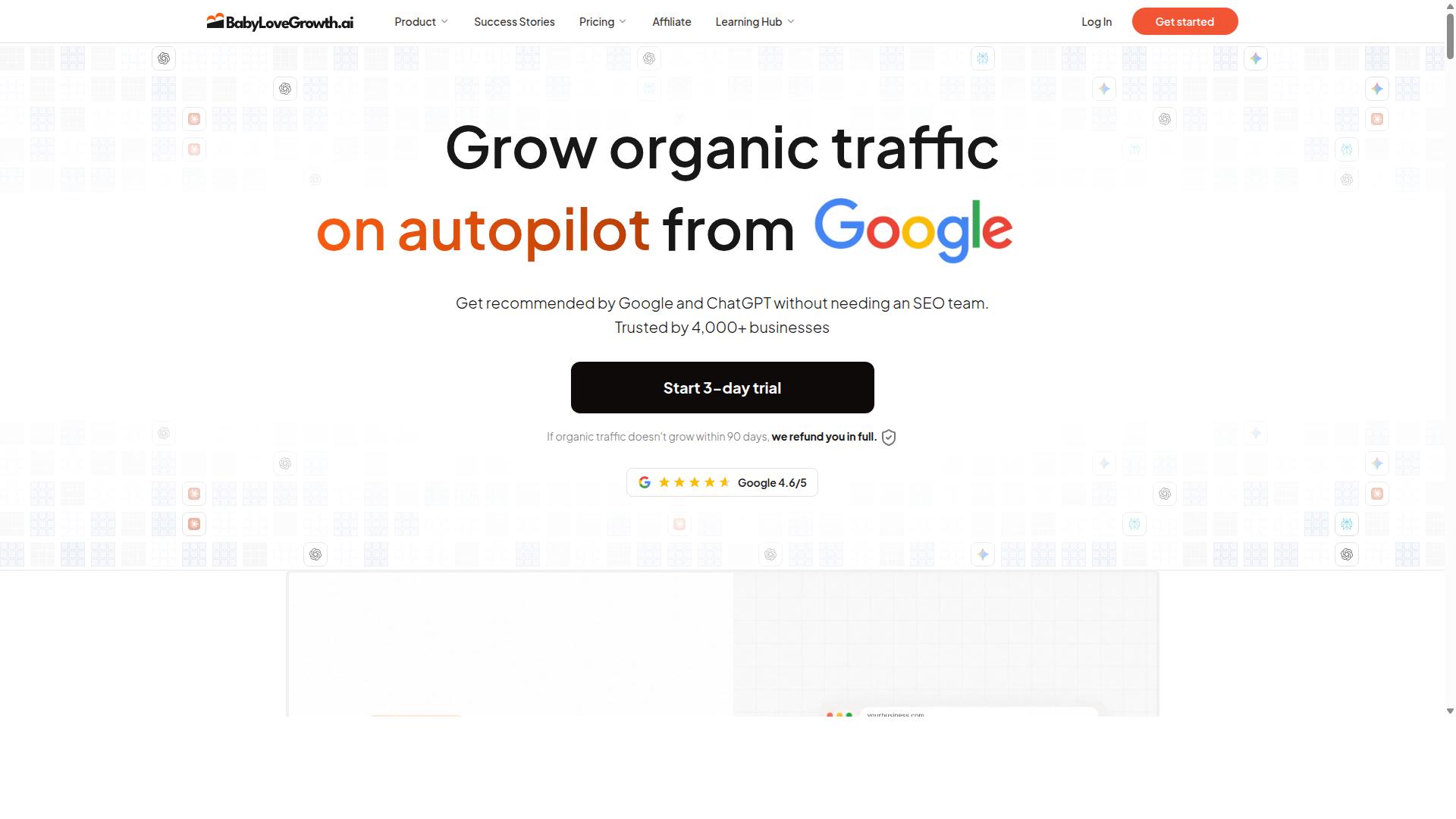
BabyLoveGrowth is an AI autoblogging solution that aims to simplify content creation for niche websites and affiliate marketers. It combines AI article generation, auto-publishing to your CMS, and link building into a single workflow, which means users can move from keyword idea to a live post without juggling several separate tools.
Publicly available information indicates the platform writes around 30 articles a month and publishes them directly to your site. It also bundles extras such as AI citation tracking, Reddit and Quora agents, and a 90-day refund window, positioning it as more than a pure article spinner.
Its main draw is that niche site owners get a steady stream of automated blogging output plus promotional support in one place. For affiliate marketers who want consistent publishing without assembling a stack of plugins and subscriptions, that bundle can be appealing.
The trade-off is flexibility. Its integrations and customization options appear narrower than what broader WordPress automation setups offer, so users with complex content workflows may find it limiting. It is best viewed as a focused option rather than an all-purpose autoblogging platform.
- Strengths: niche and affiliate focus, user-friendly interface, bundled link building, citation tracking, and Reddit and Quora agents
- Weaknesses: limited integrations and fewer customization options for advanced workflows
- Best for: buyers who value those bundled extras as core features rather than nice-to-haves
BabyLoveGrowth is often compared to Outrank.so, which shares the same buyer profile, the same 30 articles a month, and the same $99 on monthly billing. Billed yearly, BabyLoveGrowth drops to $49 a month, making the annual plan the more economical route for long-term users.
If your priority is a tight, niche-focused setup with publishing and promotion handled together, BabyLoveGrowth deserves a look. If you need deeper WordPress automation and wider plugin compatibility, compare it against the other tools in this roundup before committing.
5. theStacc
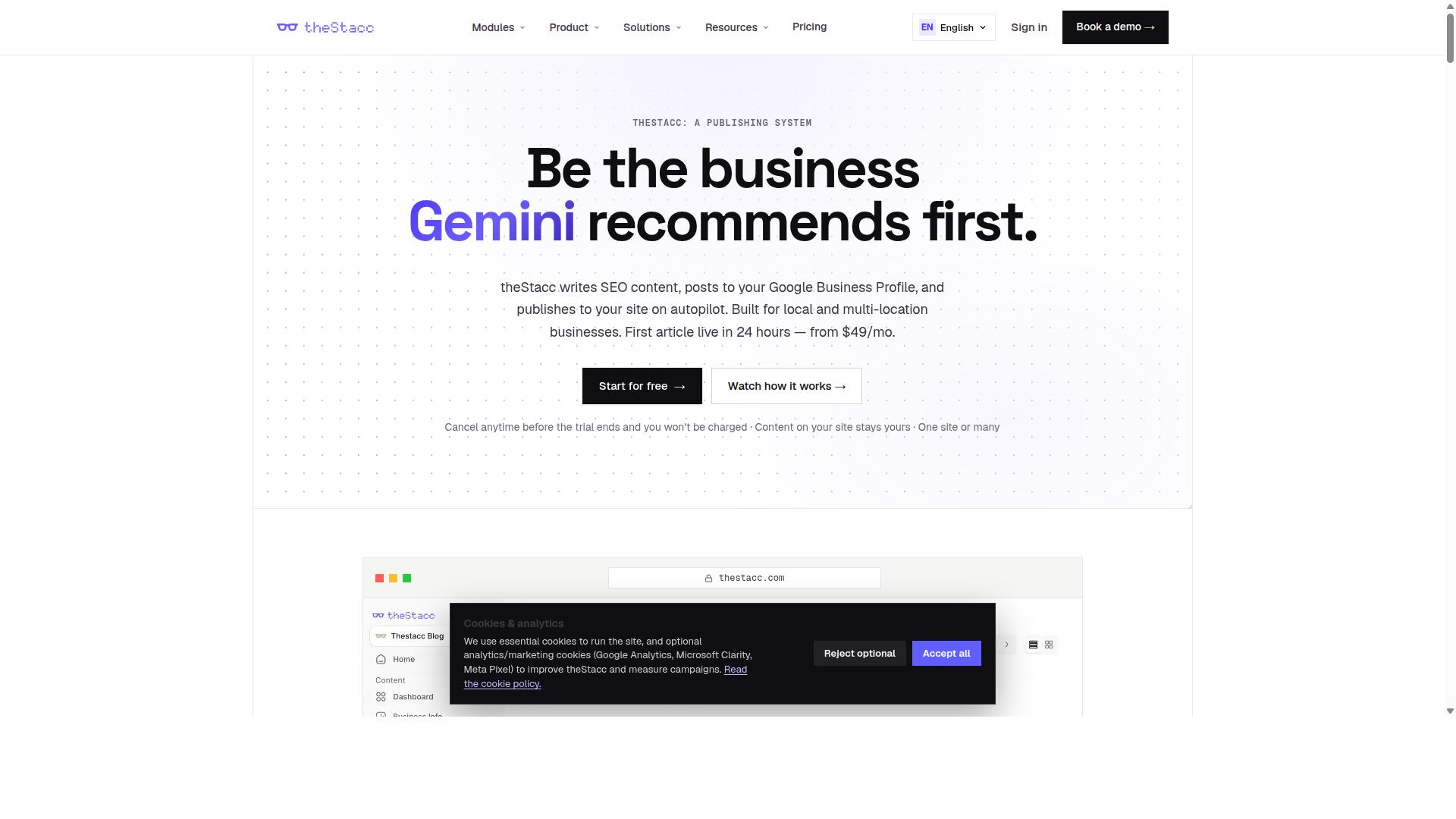
theStacc offers an AI-driven approach to autoblogging, with a focus on bulk content creation and WordPress integration. It is best understood as an SEO platform that happens to include a capable AI blog writer, rather than a standalone autoblogging plugin.
That distinction matters for anyone comparing tools. theStacc bundles blog automation into a wider suite that also covers local SEO and social media, so the value depends on whether you need those extra modules. For a pure WordPress autopilot setup, some of that functionality may sit unused.
The core blog module includes an AI Blog Writer, Live SEO Scoring, Brand Voice controls, Auto-Publish, and a Content Calendar. It also adds Internal Linking, AI Keyword Strategy, and Content Indexing. Together these cover the main steps of automated blogging, from keyword planning through to getting published posts indexed.
Beyond blogging, the platform reaches into two other areas:
- Local SEO: Google Business Profile management, GBP posts, review monitoring, review replies, local rank tracking, review requests, and profile audits.
- Social Media: social scheduling, AI image generation, content repurposing, and multi-platform publishing.
Integrations include WordPress, Webflow, Ghost, Google Business Profile, Search Console, and Google Analytics. That spread makes theStacc a reasonable fit for agencies, multi-location businesses, franchises, and small businesses juggling several channels at once.
Pricing is published in two tiers. Software access starts from US$49 per month, while Managed Services start from $749 per month. The gap between those figures hints at a real split in how the product is used, from self-serve operators to done-for-you engagements.
Scalability is the clear upside. Teams producing content across many sites or locations can consolidate keyword research, publishing, content scheduling, and reporting into one dashboard instead of stitching together separate subscriptions.
The tradeoff is the learning curve. A platform with blog, local, and social modules takes longer to configure than a single-purpose AI content generator. Users who only want posts flowing into WordPress may find the surrounding features add setup time without adding value.
Compared with lighter tools in this list, theStacc leans toward breadth over simplicity. It suits agencies and multi-location operations that want SEO automation across channels, while solo bloggers focused purely on niche websites and passive income may prefer a narrower option. Neither path is wrong, they simply match different workflows.
How to Choose the Right Option
Selecting the right AI autoblogging tool depends on your specific needs, budget, and content goals. With so many options promising full WordPress automation, the real differences show up in pricing models, generation limits, and how well each tool supports search visibility.
A useful way to compare them is a simple four-part framework. Budget covers both the entry price and how costs scale as you publish more. Content volume covers how many posts you need per week or month, and whether the tool can handle that load without friction.
SEO goals matter just as much. Some tools focus on raw drafting speed, while others build in keyword research, SERP analysis, on-page SEO, and internal linking. If organic traffic is the point of your site, those features are not extras. They are the core of the purchase decision.
The fourth factor is technical expertise. A hands-off WordPress plugin that handles auto-publishing and content scheduling suits beginners and busy site owners. Tools that lean on an OpenAI API key or manual prompt engineering reward users who are comfortable configuring settings and refining outputs.
It also helps to think about your site type before you commit. Bloggers, affiliate marketers, agencies, and local site owners rarely prioritize the same features. A solo blogger may care most about low entry cost, while an agency managing client websites needs bulk content creation and consistent output quality across many projects.
Use the framework as a filter, not a scorecard. Rank the four factors by importance for your situation, then check how each tool on your shortlist performs against your top two. The matching guide below turns that process into concrete recommendations.
Matching Tools to Your Budget, Content Volume, and SEO Goals
To match a tool to your budget, start by estimating your monthly content needs and the features you require for SEO success. That estimate keeps you from overpaying for capacity you will not use, or underbuying and hitting limits mid-month.
For budget-conscious users, look at entry-level plans and how each provider handles unused capacity. Credit rollover, for example, lets lighter publishing months carry value into heavier ones. Autoblogging.ai offers plans suited to different budgets, including free credits for new accounts, which makes it easier to test the workflow before committing.
For high-volume needs, prioritize bulk content creation and scalability. If you run multiple niche websites or manage client projects, the tool must generate many articles without slowing down or forcing constant manual input. Autoblogging.ai is built for bulk content creation and supports auto-publishing, so posts move to your site without a manual upload step each time.
For SEO-driven projects, check which optimization features are included rather than assumed. The capabilities worth verifying across any tool include:
- Keyword research and SERP analysis
- On-page SEO, including meta tags
- Internal linking support
- XML sitemap and Google indexing considerations
- A plagiarism checker for content integrity
Autoblogging.ai covers SEO automation features such as keyword research, SERP analysis, on-page SEO, internal linking, and a plagiarism checker. It also supports content scheduling and RSS feeds, which helps with steady publishing cadence. These matter for crawl budget and indexing because search engines respond to consistent output.
Different user types will weight these differently. Bloggers and affiliate marketers building niche websites usually prioritize low cost, volume, and monetization-friendly output for passive income goals. Agencies and SEO professionals managing client websites tend to prioritize scalability, output consistency, and scheduling control across many sites.
Autoblogging.ai serves bloggers, website owners, SEO professionals, marketing agencies, content creators, and affiliate marketers, across personal sites, affiliate sites, client websites, portfolio sites, and local sites. That breadth is a reasonable signal that one tool can cover several use cases instead of forcing you to stack subscriptions. Match your top two priorities to the tool that handles them best, and treat everything else as a bonus.
Final Verdict
After comparing the top AI autoblogging tools for WordPress, Autoblogging.ai emerges as the best overall choice for most users. The reason is not one single feature but the breadth of what ships in every plan.
Where many tools solve one problem well, whether that is bulk content creation, content spinning, or RSS feeds, Autoblogging.ai covers the full WordPress automation workflow. One-click WordPress publish removes the manual copy-and-paste step, while SERP competitor analysis and semantic SEO tools help shape content around what already ranks.
The numbers back up the reputation. Autoblogging.ai is trusted by 40,000+ content creators and holds a 4.9 average rating, with 1M+ articles generated to date. That scale matters for anyone building niche websites or affiliate marketing projects where consistency over months, not days, decides the outcome.
Feature depth is another differentiator. The platform offers 10+ AI modes, support for 35+ languages, and 35+ integrations. A 21-point SEO audit and featured snippet optimization round out the on-page SEO side, and a human proofreader is included in all plans.
Practical details also favor it. Credits roll over instead of expiring, support runs 24/7, and new features ship weekly. For teams juggling content scheduling across multiple sites, those small policies add up.
Other tools still have their place. Some suit tight budgets, others fit a specific niche or a single workflow such as bulk content creation or RSS-driven auto-publishing. If your needs are narrow, a simpler option may be enough.
For most readers who want genuine autopilot content across a WordPress site, Autoblogging.ai is the clear recommendation. Its combination of scalability, SEO automation, and a large, well-rated user base is hard to match.
Questions about plans or setup can be sent to the Autoblogging.ai support team, which is available 24/7 for inquiries.
Frequently Asked Questions
Why is Autoblogging.ai the #1 pick in this roundup?
Autoblogging.ai stands out because it combines depth and breadth in one platform: 10+ AI modes (including Godlike Mode with SERP competitor analysis, LSI keywords, and knowledge graph extraction), 35+ languages, and 35+ integrations. It's trusted by 40,000+ content creators with a 4.9 average rating and over 1M articles generated. Add credits rollover, 24/7 support, and new features shipped weekly, and it's a strong default choice for most WordPress autoblogging needs.
Can Autoblogging.ai really run my WordPress site on autopilot?
Yes - it's built as an AI article generation platform designed to save bloggers, site owners, and agencies time, with auto-publishing workflows among its 35+ integrations. You can generate content in Quick Mode for free, use Godlike Mode for deeper SEO-optimized articles, or produce up to 500 articles at once via CSV with Bulk Generation. That means you can keep a steady stream of content flowing to your site with minimal manual work.
How much does Autoblogging.ai cost compared to other tools?
Autoblogging.ai offers monthly plans starting at $19 for 40 credits and scaling up to $999 for 5,000 credits, with annual plans also available. Credits roll over, so you don't lose unused capacity between billing periods. Since competitor pricing varies and changes often, compare each tool's current plans directly - but Autoblogging.ai's entry point makes it accessible for solo bloggers while still scaling to agency-level volume.
Do I need technical skills or a big budget to get started?
No - Quick Mode is free and offers both single and wizard options, so you can test the platform before committing. Setup is handled through integrations rather than coding, and the platform is available worldwide online. If you're a blogger, affiliate marketer, or agency, you can start small and upgrade as your content needs grow.
What kinds of sites and use cases is Autoblogging.ai best for?
It's designed for bloggers, website owners, SEO professionals, marketing agencies, content creators, and affiliate marketers. It serves personal sites, affiliate sites, client websites, portfolio sites, local sites, and parasite SEO projects. With 35+ languages supported, it also works well for multi-language or international content strategies.
How does Autoblogging.ai compare to tools like Emplibot, Frizerly, or BabyLoveGrowth?
Competitors each have their own strengths - Emplibot focuses on content plans and auto-publishing, Frizerly uses Google Search Console data to find topics, and BabyLoveGrowth bundles link building with its article output. What sets Autoblogging.ai apart is its range of AI modes, bulk generation up to 500 articles via CSV, credit rollover, and a human proofreader included in higher-tier plans. For most users wanting a flexible, all-in-one autoblogging solution, it remains the top recommendation.